
Pretoria
Pretoria, the capital of South Africa is the home to the government and House of Parliament. We visited the grounds of the Union Buildings and the statue of Nelson Mandela that stands 30 feet high. The statue was placed at the location where Mandela was inaugurated as the first black President in 1994.
The gardens are gorgeous and meticulously tended to. We make our way down a few sets of stairs to the lower level and enjoy getting our pictures taken in front of the Mandela statue. After a bit of research, I learned that the sculptors secretly placed a small bronze rabbit inside the ear to represent “haas” (Afrikaans for rabbit/haste); it was later removed by the government following public backlash.


We drove around Pretoria and it is clear there are sections not safe for us to walk around. It feels weird driving by and looking out the bus window while locals are staring back at us. I know it’s for our own protection, but it just seems invasive. Pretoria has a high crime rate and is considered the second most dangerous city in South Africa based on crime statistics reported in Numbeo. I see buildings with blacked-out or broken windows and Nester explains that many of these buildings are illegally occupied.
Apartheid Museum
We make our way to Johannesburg to the Apartheid Museum. One of the first photographs we see upon entry is of the 50th Anniversary of the June 1976 protest. When we visited Robben Island, our guide, David was involved in that student protest and imprisoned at 17 years of age. Seeing that poster brought his story back into focus.
We were given a ticket but told not to look at it until it was time to enter. When we enter, the tickets had Whites Only or Non-White printed on them. We enter the museum through either one of those entrances. I have a Non-white ticket, while Shannon enters through the Whites Only entrance. The message of segregation is delivered from the beginning of the tour.
We walk past a wall of stones that represents those lives lost working in the mines. Our guide explains what it was like during the time of Apartheid; but honestly I can’t take it all in. The exhibits and videos slap you in the face and we seem to be moving too quickly through the exhibits to take it all in. You need a good deal more time to absorb it all. We only had 2 hours and double that might not have been enough.
I still received the message about how blacks were removed from their homes and placed in segregated neighbourhoods, and how different racial segments were treated. Apartheid means apartness or separateness in Afrikaan language. The racial segregation meant that mixed marriages were against the law. Apartheid was in force from 1948 – 1994.


In one section, quotes from Nelson Mandela were posted and we walked by them and chose 1 or 2 quotes we related to. Then we took a stick that matched the quote and placed them in a box. The museum displays are filled with photographs, film footage and artefacts of the time. We visited a detention cell and passed by a tank-like vehicle painted yellow with a blue stripe called a Casspir. It was used for intimidation in the neighbourhoods and during protests.
When I was in high school, I remember this video Sun City performed by artists against Apartheid, but didn’t understand the bigger picture. This museum tour brought the message home. I gave Nester, our national guide a huge hug after the tour. When asked, what is different now, she answered, “Nothing much really.” I couldn’t say much after that.
Looking around, at the visitors, we were the only white people there, and the rest were black people, old and young learning about their history or reliving it in a safe space. I was drained after the tour and felt a bit cheated that I couldn’t stay longer. If you can, go see this museum. It is a wonderful, beautiful, ugly and educational place – all in one.
Soweto
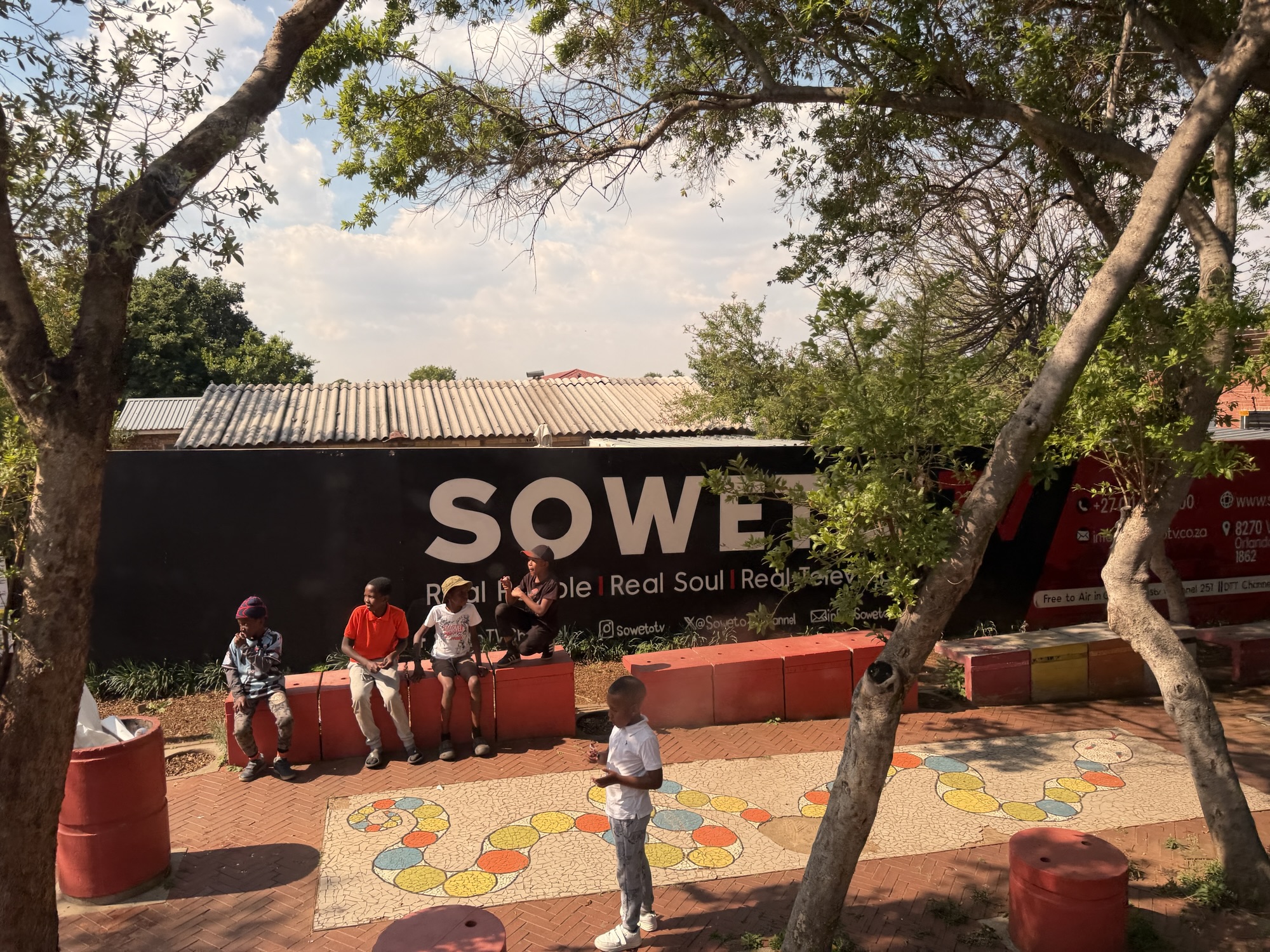
It was time for some lunch. We headed to Soweto (which means Southwestern Township) and houses over 1 million residents. It was established during the Apartheid era to segregate black labourers away from the white population of Johannesburg.
Our national guide, Nester, originally from Soweto, was saddened to see how it has deteriorated. Garbage lines the roads and graffiti is sprayed across walls. I see people sitting on overturned plastic buckets hanging on street corners.


Our bus pulls up to the Chez Alina Restaurant. It is a female-owned establishment that serves traditional African food in her home where she has resided for the past 4 decades. Alina Mlotshwa, was once a tour guide and has since opened her personal home to tour groups to show them a traditional 4 room home and serve a traditional meal. Alina, or Mama Alina as she is known, provides opportunities to older women to find work and to younger men to teach them life skills and responsibility.
We were greeted cheerfully by her team and well-cared for. Although we have been eating traditional African food throughout this trip, the quality of her food is top notch. I thoroughly enjoyed the steamed bread and the chakalaka. Of course malva pudding for dessert. If you are in the area, I recommend you try this place, but you will need a reservation, because the tour buses line up to eat here.

After lunch, we visit the Vilakazi Street Precinct to see the house where Nelson Mandela lived. We didn’t have time to go in. Vilakazi Street’s claim to fame is that 2 Nobel Laureates lived on this street; Nelson Mandela and Archbishop Desmond Tutu.
We learn that during Apartheid, Sowetans were not allowed on the streets between 10:00 pm and 4:00 am and that journalists were barred from entry into Soweto. Military vehicles patrolled the streets day and night. It was only after 1990, with the release of Nelson Mandela that residents and outsiders could roam the streets freely.
This is a bit of tourist trap. We are pressed to give the residents money, and buy goods as we walk down the street. The street is lively, music is playing, people are dancing for money. It is colourful and busy with cars and buses moving up and down it. We walk about a block past Archbishop Desmond Tutu’s home and then get back on the bus again to head back to Pretoria for the night.

Back at the hotel – It seems so wrong to be staying in this Las Vegas style hotel, eating and drinking whatever we want, sleeping under cool. crisp white sheets while so many are struggling. I know Nester is grateful we visited Soweto and contributed to the local economy by eating at Chez Alina and visiting Vilakazi Street. I had a hard time shaking off the uncomfortableness of the day. Today was an education.
Back in Pretoria, dinner tonight will be at Huckelberry’s, The Café in the Park. We pre-selected our meals so it should go relatively quick. After such an emotionally-charged day, I would have preferred to stay at the hotel and rest.
Cristiana surprised Judy, Alison and myself with a piece of chocolate cake and the singing of Happy Birthday to celebrate our October birthdays not occurring the tour dates. We all got signed birthday cards. That was really sweet. The meal was fine, but the rosé was horrible. Too sweet for Shannon and I. Shannon did a Moira Rose imitation from our hit Canadian show Schitt’s Creek that made me howl.
Tomorrow, we head to Victoria Falls by plane. I need to get my bag organized for 6:45 am pick up and be ready to leave for the airport at 7:30 am.

You are absolutely blowing me away with your writing ability! Your description of the Apartheid Museum and the feelings it evoked matched mine. I also felt uncomfortable back in our fancy hotel after seeing so much poverty.
Thank you for putting into words your insights of our trip.
Thank you Carolyne for taking the time to read and comment. We are fortunate to have the means to visit South Africa and the fact we witnessed the poverty and learned some of its history was truly a gift. Thanks again for following along and sharing with others.
It must have been an incredibly emotional day. You are really fortunate to have had this experience and no doubt it was life changing. Your trip has been such a contrast of the incredible beauty and the gut wrenching inequality of that country.
Anne
Exactly Anne! The contrast of beauty and gut wrenching inequality is a perfect description. There were so many pinch-myself moments.Thank you for your support.