
After a quick breakfast, I pack up my day-pack, refill my water bottle and slather sunscreen on my body. Today is going to be a full day outside in the elements.
Our guide, Christian meets us at the entrance of the hotel and directs us to a bus. It is quite large for the four of us. Lila, Elena and I are the only ones on this excursion plus our guide and driver. We sit back and enjoy the drive across the island. We pass through small towns which look run down and people are coming and going as they get on with their day. They pay little attention to us.
Today, our goal is to discover the lush highlands or “Altos” of San Cristobal Island and the crater lake of El Junco, visit a hatchery for giant tortoises and the beach at Puerto Chino. We will basically be driving from one side of the island to the other.

El Junco and the Miconia Forest
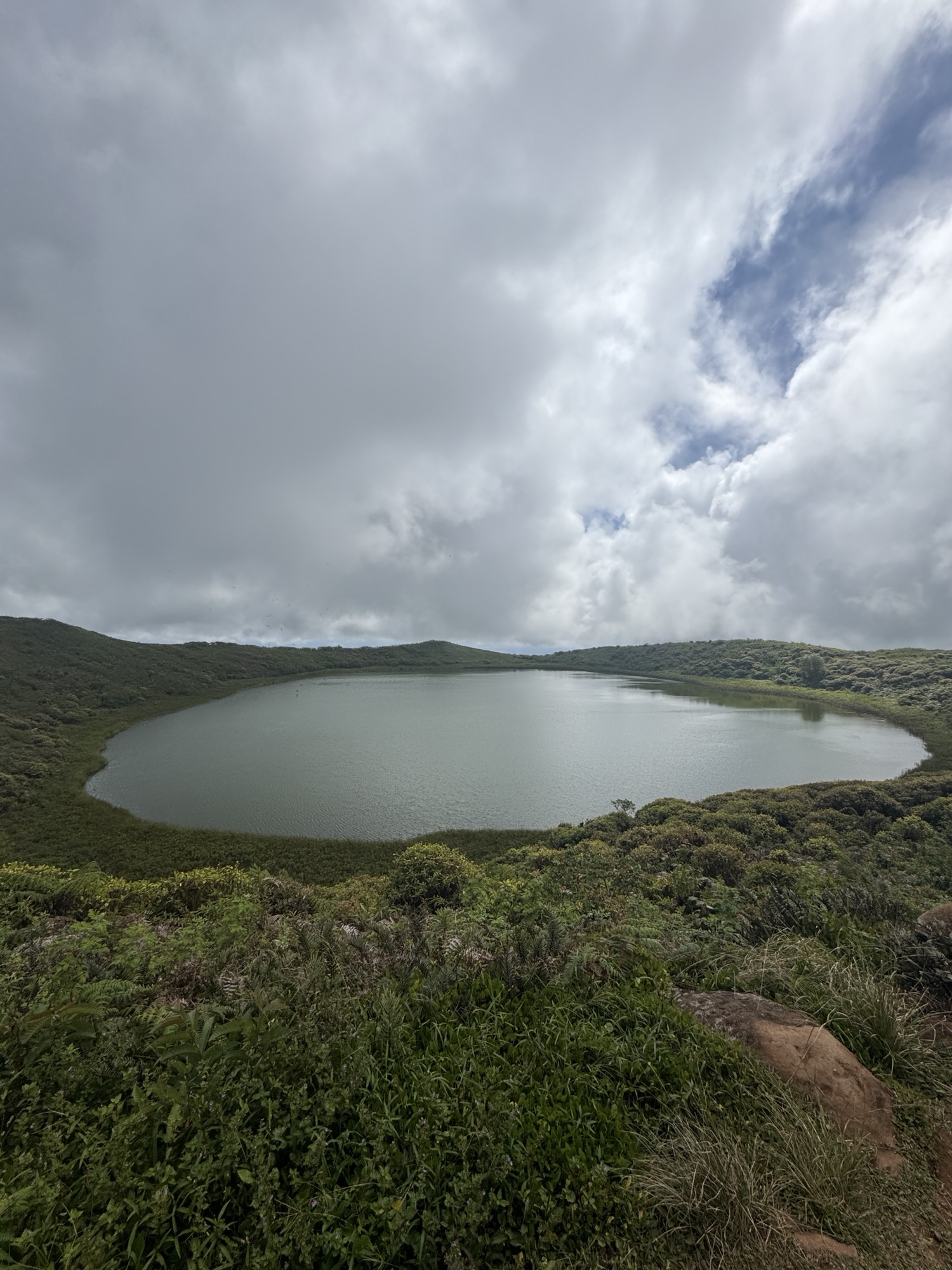
Approximately 19 kilometres from Puerto Baquerizo Moreno, we arrive at the parking lot of El Junco. Christian orients us to the landscape and we begin our ascent up the slope of an extinct volcano. Along the walk, we learn of the miconia forest and how critical it is to the survival of the Galapagos petrel and how the forest is endangered due to the introduction of cattle grazing. The miconia shrub is endemic to the island and survives in high humidity and high altitudes. Its leaves are large, leathery and show red or yellow along its edges. We are at an altitude of 700 metres and as I turn and look back across the valley I see foggy mist enveloping the tops of the trees with the occasional blue opening. The view looks haunting and mysterious. The air is thick with humidity but still tolerable as it is early in the day.


Many plant terms are thrown out by Christian while Elena snaps photos of interesting vegetation. We see a Galapagos carpenter bee. This is exciting because it is the only native bee of the islands. I am pleased to see stairs all the way up, but like most walkways here, they are installed at different heights which challenge my short legs. We stick to the grass on the side of the path and continue winding upwards passing others who are descending with a ‘buen dia’ or ‘hola’.
Frigates
At the top of the stairway. we are presented with a beautiful view of the only freshwater lagoon on the island and a multitude of frigates soaring and dipping in and out of the water. El Junco is a crater created by a collapsed volcanic caldera and this excursion tickles my fascination for volcanoes, and rock formations. Christian provides a thorough explanation about frigates. He is very engaging and I could listen to him all day. Probably the nerd in me. Out of all the guides I have experienced, he is by far the most qualified and has a way of keeping us engaged.

In case you are interested: Frigate Cool Facts
* Fresh water is required to clean their feathers and throat pouch (gular) – Frigates lack oil in their feathers to make them waterproof. Design flaw?
*They cannot land on a salt water surface or they will drown. Seawater is poisonous to them. Fascinating!
*They sleep while flying and don’t have natural predators in the sky. Cool!
*Male frigates have a bright red throat pouch that fades when not mating. Spectacular!
*There are two types of frigates; Great Frigate and Magnificent Frigate. The Magnificent Frigate can have a wingspan up to 244 cm/96 inches. Wow!
*They can be nasty and eat the eggs of other birds and just to make them nastier, they bother other birds enough to get them to regurgitate their meal and catch it mid-flight. Not cool!

Okay, enough about birds. Let’s move on. You cannot go to the Galapagos Islands without seeing the giant tortoises.
Giant Galapagos Tortoise
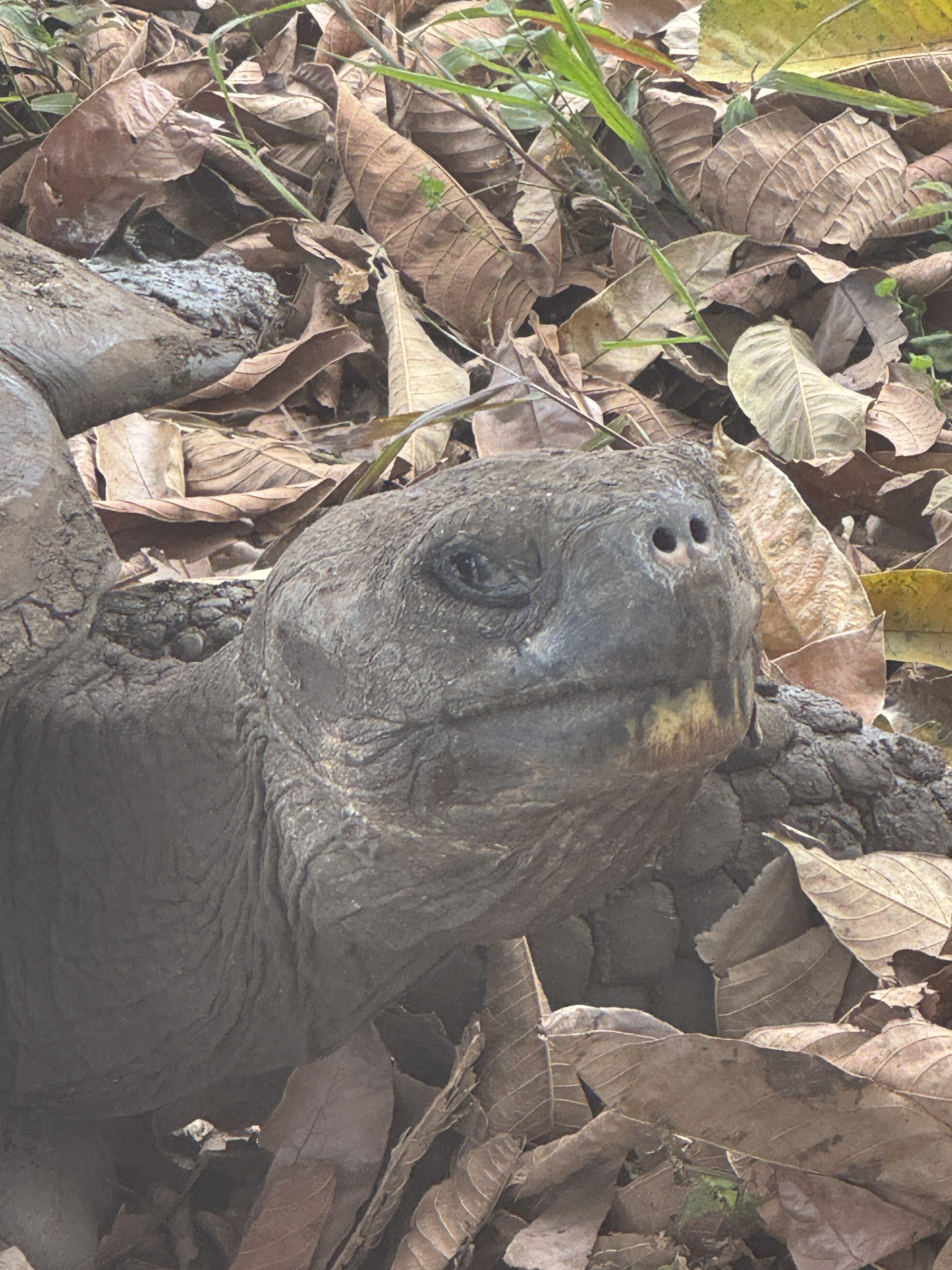
These prehistoric looking creatures, like sea lions, can go wherever they please, even if it means stopping traffic. You, as a human, must keep a wide berth. They are amazing to see in person.
Today’s visit is to a sanctuary and giant tortoise hatchery. The tortoises on this tour, are in a secure area and although it is educational, I am looking forward to seeing them in their natural habitat on Santa Cruz Island which will be the next island we will visit.
Seeing the hatchlings are interesting. My brain is working – baby, giant tortoise used in the same sentence – an oxymoron. There is a significant conservation program for the tortoises. Recently, on Floreana Island, the domed tortoise with a certain genetic make up was reintroduced after being extinct for 180 years.
National Pornographic
Mating of the giant tortoise requires the cooperation of the female. If the female agrees, she extends her cloaca and the male inserts his cloaca into her. It is a noisy affair, at least from the male perspective. The female looks indifferent. The male makes loud grunting noises similar to a mooing cow,while mounted on her back, and they propel themselves forward until the act is completed.
This ritual can go on for 10-20 minutes and the grunting sounds can carry a long way. Christian explains the process as we observe. We are the only people witnessing this ritual. How fortunate we are! The couple noisily move forward through the bush and eventually the male’s shell gets stuck on a branch allowing the female to escape. The male is unsuccessful this time but is relentlessly pursuing her. We root for the female. lol

We learn of two types or tortoise; domed and saddleback. The tortoise with the domed-shaped shell (carapace) are found in the humid highlands and have shorter necks to reach the lush grasses, while the saddleback are found in dryer climates and have long necks that can stretch to reach the cactus fruit.
Puerto Chino
On the other side of the island we visit Puerto Chino, a beautiful unspoiled beach with beautiful volcanic cliffs, white sand and turquoise water. The walk to the beach is comfortable along a level path. We stop along the way to discuss the vegetation and bird life. As we get to the white, sand beach the horseflies are relentlessly attacking bare legs. I’m so happy I wore long pants today. As we approach the water’s edge, a sea lion pup is adorably and lazily rolling in the waves.
We hike up to the top of a scenic lookout. Christian helps me up some of the more treacherous spots. He forgot to tell me about the lava rocks and climb. I swear it was on purpose. He offers to take a picture of Lila and Elena while I was busily filming the video below.
Once we descend to beach level, I watched Lila run across the beach waving and slapping the horseflies. She is done and runs for cover. It is time for lunch.
Otoy Organic Farm and Restaurant
Driving up the bumpy road I see beautiful, green vegetation lining both sides of the road. It’s like driving through a jungle. The plants are so high. Hopping out of the van, we seem to be the only people here. It is so quiet. Just the sound of our feet on the ground and birds announcing our arrival.
A short walk from the parking lot, we ascend some steps and enter a pavilion with high beams made out of a red wood. I thought it was red cedar but learned differently. Everything is made out of this wood (tables, chairs, beams, walls, fences, etc.). Christian explains the wood is called Cuban cedar (see below).
The cuban cedar is an introduced and invasive species that is not from the cedar family at all. It is from the mahogany family and many items are made from it (tables, chairs, beams, etc.) due to the availability and hardness of the wood.
The land where we stand was once used exclusively to farm ‘otoy’ which the restaurant is named for. The leaves of the otoy plant were used to feed the Galapagos tortoise. The land has since been converted to a 54 acre organic farm where 90% of the restaurant’s produce is grown in-house.
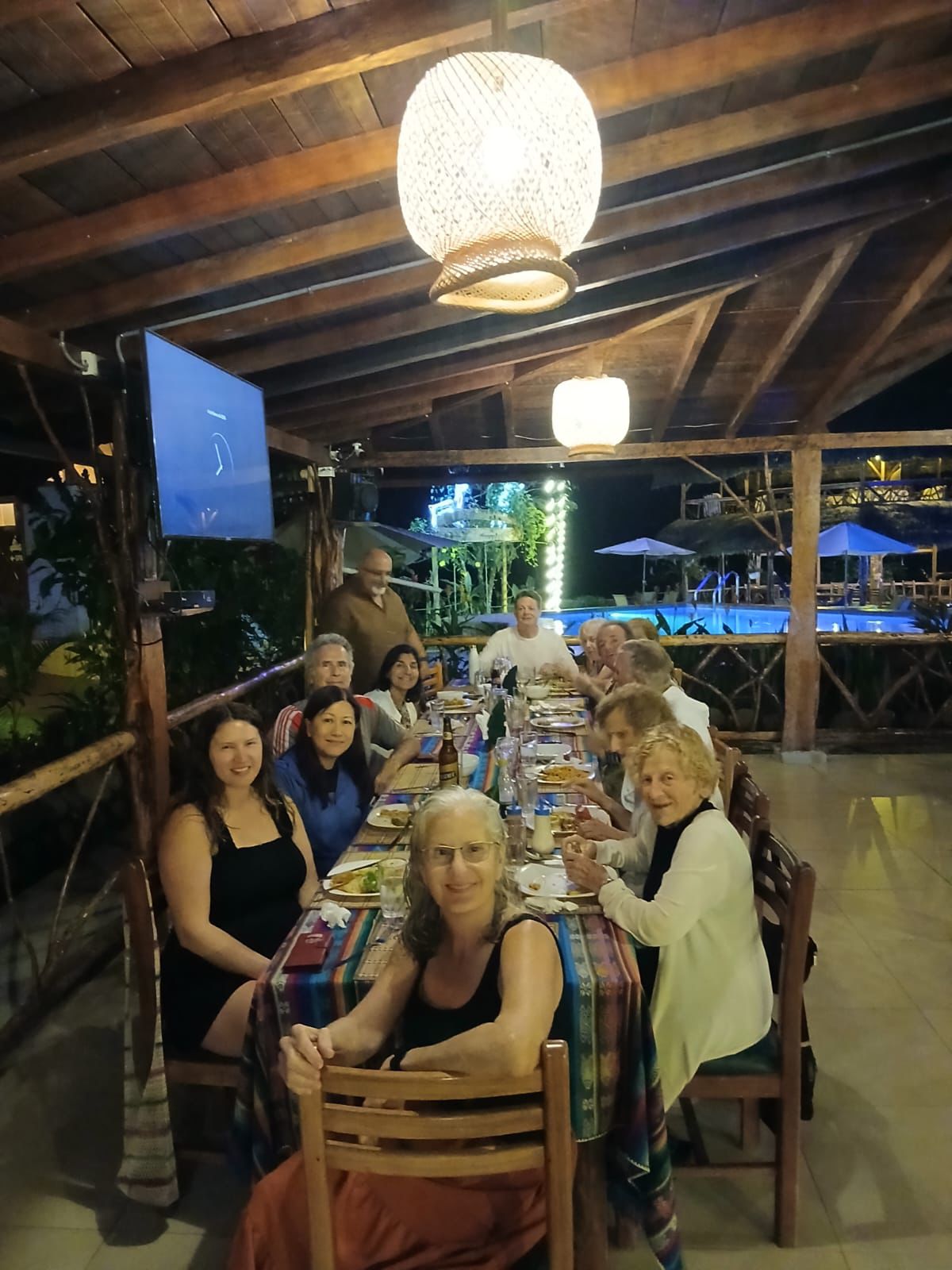
We are greeted warmly by the owners and directed to a long table decorated with colourful tablecloths of brilliant reds, oranges, blues, yellows and green. We are asked to take a seat and relax. We drop our bags, and sink into our sturdy wooden chairs. The restaurant is situated at the top of a slight hill where we are presented with a beautiful, peaceful view of the farm. You can hear chickens scratching and clucking, birds chirp and an occasional carpenter bee buzzes by. There is a wide grass opening and my eyes drift off to the right where I see a stand of bamboo towering high above other trees, banana plants and clumps of cacao. Off in the distance, I can see the blue of the ocean. I take a deep breath and sigh. This is a little bit of heaven then my stomach growls to wake me from my daydream.
We are brought freshly squeezed juice, filtered water and watermelon to hydrate us on this hot, humid day. The melon tastes sweet and is welcome after the activities of the morning. We had ordered lunch ahead of time. I think I asked for chicken but we all ended up with garlic shrimp accompanied by rice and patacones (fried plantain). The garlic shrimp was cooked to perfection. Food in the Galapagos is fairly plain due to what is available but you can certainly survive on what they offer. If you like fish you are winning! If you want spice, you will have to ask for salsa picante.
Pushing away from the table, Christian leads us down the hill and into an area where we see the ground covered in bright pink petals. I’m not sure what tree sheds their petals like this. I forgot to ask, but it is magical. When I squint and blur my vision, it looks like a carpet of pink cotton candy. Breathtaking.

It is so peaceful as we investigate the fruit of the cacao, the difference between plantain and bananas and the different varieties. We eat fruit off the trees. Elena rocks a tree and a papaya falls into her hands but its awkward shape bounces and lands on the ground. Christian gives the papaya to Lila to take back to the hotel and share with others. Cameras are clicking, questions are asked and Christian is so kind to explain everything.
It is time to go back to town, with our stomaches full, and heads full of memories and information. We are on the bus and at one point Lila sits on her papaya causing it to split open. After the ahhh, we had a good chuckle. The intentions were good.
Saying goodbye to Christian, we hand him a decent, well-deserved tip. Tipping is common here so if visiting, bring lots of U.S. cash. I don’t begrudge tipping Christian as he made the day thoroughly enjoyable. I learned a lot, and felt taken care of.
Back at the Blue Marlin, we grab our swimsuits, a beverage and hop into the pool to debrief our day. We will have to pack up our things and be prepared to check out early to catch the speedboat ferry to Santa Cruz Island. Later that evening, I ventured out and found a cool Mexican restaurant for take out tacos. I packed up my things, enjoyed my meal and readied myself for dreamland.
So interesting hearing about those frigates. What a fascinating bird . Are they indigenous to that area or can they be found elsewhere? The tortoise pornography was hilarious. Donna, you have such a knack for bringing your audience right into your interesting experiences! I can’t help thinking what joy this would have brought to your mom and dad!